Yesterday's Weather
A free daily music report by Milieu
"Forecasting the past from the Cleveland wind tunnel, a day late and a dollar short."
Yesterday's Weather is the first series of its kind in the Milieu
catalogue - a unique piece of music published for free each day for one
calendar year.
The series functions according to a number of predetermined guidelines
that I've developed and arranged ahead of the year-long run, and this
work has been done
beforehand in order to fulfill all possible contextual needs and
decisions with the noted exception of the
music making process itself.
Each day, a new recording of arbitrary runtime length and genre
classification will be made using my modular system, and published the
following day at Bandcamp.
Each recording will be accompanied by the weather report in
Cleveland
for the previous day, alongside any relevant patch notes from the
session.
At the end of each calendar month, each track will be collected into a
single album release at Bandcamp and given a cover design
reminiscent of a
temperature blanket, displaying in vertical order from top to bottom each day's unique
color palette.
Of these palettes, 120 two-color and three-color sets and 108 four-color
sets originated from Sanzo Wada's
"A Dictionary of Color Combinations,"
while the year's
remaining 17 palettes consist of two ROYGBIV color wheels swatched from
14 various hardware machines in my
ZOR
studio that I have collected throughout the years, plus the
monochromatic spectrum of white, grey and black to provide
beginning/middle/end milemarkers and subsequently make up the full 365
days of the year.
These 17 dates of exception were all chosen for moments of personal
significance, such as birthdays, anniversaries and milestones related to
specific totemic numbers.
Yesterday's Weather is intended to explore a number of different
avenues and perform a number of different functions in my creative work,
in addition to simply
existing as a public-facing sketchbook, a travelogue within my creative
process over 365 days. Firstly, it is being guided by unique machines
that have been designed
to produce different sets of useful timing or modulation information
every day, offering only a brief window of time to explore them before
they change again, and
encouraging me to focus on making the music that can only be made today
- a blank page of now, unable to be fully influenced by the previous
day's work and free of concern
for what might come tomorrow. To this end, each day's track will be
without overdubs - what you hear will be what comes out of my modular
system, 1:1,
farm to table.
Secondly, it is no secret that I am once again joining Rudolf Kremers at
Omni Systems
in England, recording a brand new original soundtrack for
the forthcoming video game
"Eufloria 2."
Yesterday's Weather will function as a filtering process of
ongoing session work, much like the Analog Botany series
in 2009 was designed to sift out the best pieces to build into the
Pawleys Island double-album. Writing the soundtrack for the
original
"Eufloria"
remains
one of my proudest moments as a musician, so it follows that I should
approach the follow-up with this level of consideration.
Finally, Yesterday's Weather will also function as the
White Pillar series did in 2017 - as I am finally settled enough
in my new home to consider my
ZOR
studio to be
almost completely functional, having this series to informally explore a
full year of making recordings in this new space, determining only
through rigorous trial and error
what feels natural and unforced in a building constructed in
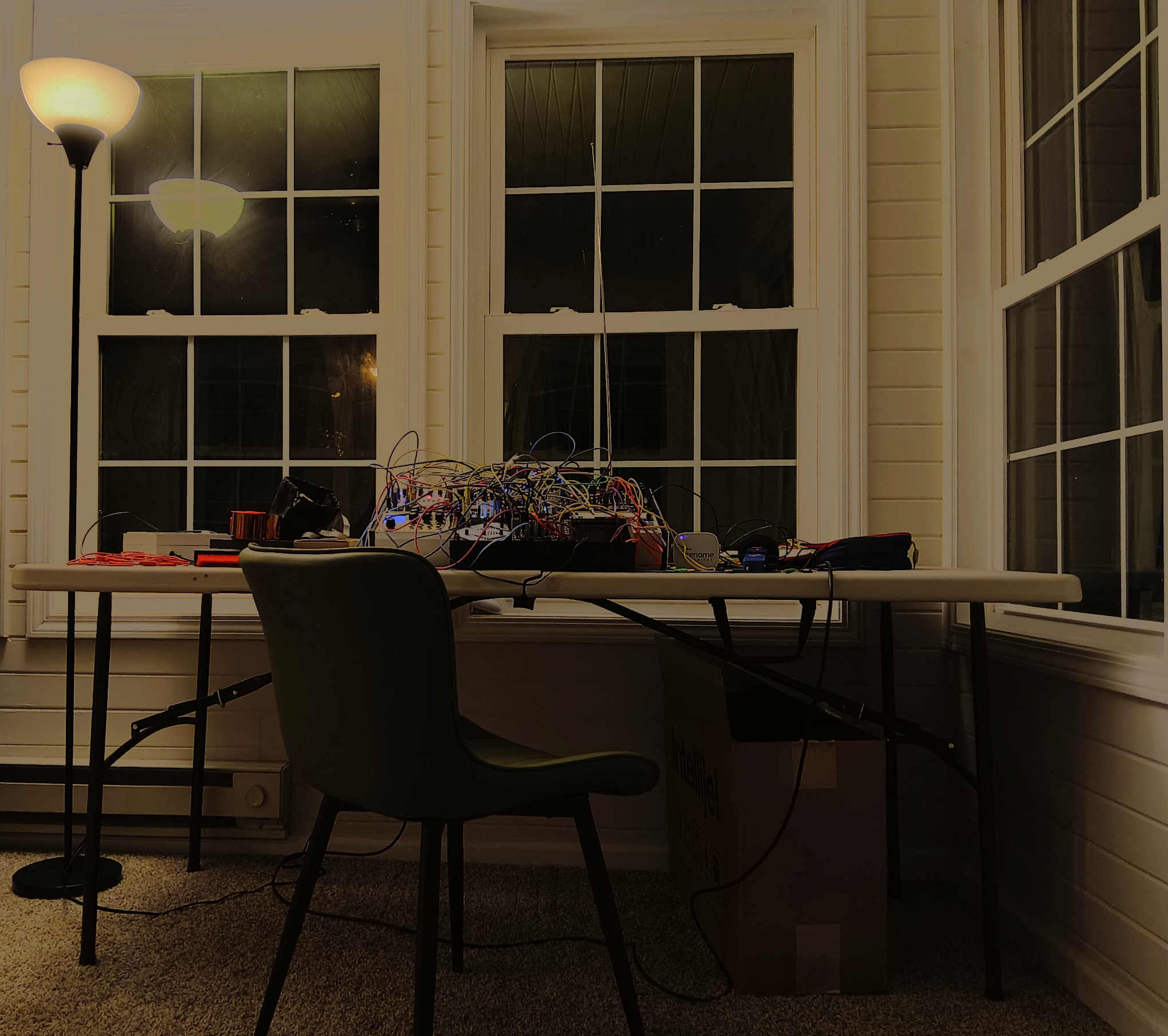
1937. For this reason especially, the modular system I've developed with
the series in mind is a fully portable one
housed in a metal case with a lid and a handle, designed by
Intellijel. It is able to be closed and mobilized while fully patched, and allows
me the ability to set up a fully
efficient studio anywhere I can find an outlet - even outdoors - and the
range of possibilities made available through this portability becomes
even larger when you consider
that this system includes an AM/FM radio antenna and six different bands
of shortwave, as well as
piezoelectric microphones
and a
light-dependent resistor
theremin.
The series can then exist just as much as a documentary process of the
spaces my music and family now inhabit, in a way that feels
simultaneously both naked and obscured.
The system has been carefully plotted out and re-organized several times
over the last month after I first acquired the case. I wanted to have as
much patch programmability
as possible present in the workflow, allowing most individual modules to
be able to perform several different tasks in a given patch. Multiple
modes of synthesis are available to
provide a myriad of variation in the voices of
Yesterday's Weather -
Karplus-Strong,
wavetables, 6-operator
FM synthesis,
subtractive
analog, digital and analog
noise
generators
and most things in-between - as well as many different methods of
post-processing paths with delay systems, reverbs, filters, phasers,
spatial mixers,
looping
devices, feedback routers, granular processors, equalizers, compressors
and more. It is both compact and extremely versatile, and even just
writing about it here fills me with joy.
I hope you'll join me for this run, which is certain to be unique even
after all the varied series I've operated through the years -
Analog Botany, Workingman's Drone, Verdant
Acre, Astral Salons, OHMM, Static Pharming, Chrysopoeian Waves,
Vibratelepathos, Houseworks, White Pillar, Naked Sound,
Deep Earth, the list just goes on forever it seems like; and yet
none of them went so far as to offer you a new piece of music
every single day of the year, and to do it free of charge as well
- so I hope this allows the music to meet you
where and when you already are, because now and here are
all we ever really have in this life anyway.
Special gratitude is owed to
Jonah Senzel, whose ever-changing machines
Supra
and
Pet Rock
have allowed such a serialized work to come to pass,
and also to Sanzo Wada for his pioneering development of color theory
with his 1933-34 six-volume work "Haishoku Soukan"
later collected as
"A Dictionary of Color Combinations,"
which provided all but 17 color palettes used for this series.
A nod of gratitude goes out to the great
Jim Kirby, who planted the seeds of the free daily music upload series so many
years ago at the dearly missed
V/Vm Test.
Additionally, my deepest appreciations go to the many people who have
developed and contributed to the open source platforms that I use every
day in
my modular ecosystem: Noise Engineering's
Versio
and
Legio
machines, Allen Synthesis'
EuroPi
and the three different firmware builds
for
Ornament & Crime
(the original by Stadler/Dowling/Churches,
Phazerville
and
Squares & Circles). Emilie Gillet for the essential
Mutable Instruments
canon,
Chris Johnson
for his innovative work with
Airwindows, and all at
4ms
and
VCV Rack
for their incredible work on the Meta Module.
Finally, there can never be enough praise for
David Burraston (NYZ)
for his perennial mentorship and assistance in all avenues of synthesis,
programming and philosophy,
as well as his generous providing of more custom wavetables, FM
synthesizer patches and tuning systems than I could ever possibly
use.